Society Class 11
THE CLASS STARTED WITH A BRIEF OVERVIEW OF THE PREVIOUS TOPICS (01:06 PM)
ETHNONATIONALISM (01:08 PM)
- Ethnic Group:
- It is defined as a social group consisting of people united by common history, ancestry, experiences, culture, etc.
- People have sufficient awareness that they are similar but distinct from others.
- Ethnic identity-> Differential access to resources based on ethnic identity-> Ethnic Stratification -> Ethnic Antagonism -> Subjective realization of objective reality -> leads to Ethnonationalism.
- For Example, Sri Lankan Civil War: Sinhalese and Tamil group.
- The Ceylon Citizenship Act, Sinhala Only Act, and Buddhism as the state religion, the ban imposed on the import of Tamil Literature created differences among them.
UNITY IN DIVERSITY (01:30 PM)
- Unity is defined as a sense of 'oneness' or 'We feeling' which binds people together
- Unity can be based on uniformity or even differences.
- There are different bonds of unity.
- 1) Geographical bonds:
- a) Geo-Political Unity:
- We all stand geographically united with the Himalayas in the North and Oceans on the sides.
- amidst this geographical unity we are also politically united.
- For Example, Common political culture, Single Constitution, Single Citizenship, etc.
- b) Geo-Cultural Unity:
- Institution of Pilgrimage:
-
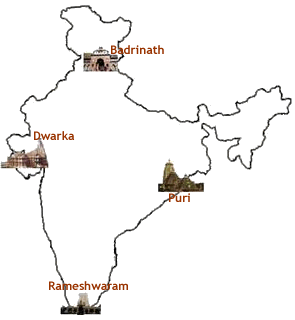
- North: Badrinath,Kedarnath.
- East: Puri
- West: Dwarka
- South: Rameshwaram
- These institution of Pilgrimage plays a part in promoting interaction and cultural affinity among people living in different parts of India, hence it is the source of unity which is reflected in the network of sacred places and shrines.
- 2) Regional Bond of Unity:
- Region 1: Amidst caste diversity, There exists a vertical bond of unity based on a common language.
- Region 2: Amidst the regional diversity there exists a horizontal bond of unity among people of the same caste.
- 3) Religious Bond:
- a) Inter-religious Bond:
- Amidst religious diversity, there exists a common objective of 'earning religious merit by visiting religious shrines'
- b) Intra-religious Bond:
- Amidst this Intra-religious diversity with respect to sects/cults.
- It is the teachings of religious scriptures which bind people together.
- Misc Examples:
- Educational Institutes, rented accommodations, Public transport, All India services, Political parties, Cinema, Food, patriotism, corporate culture, Social institutions, etc.
DIVERSITY IN UNITY (01:57 PM)
- It refers to the 'existence of plural culture within the nation'
- the concept of "Diversity in Unity" means diverse people, cultures, and communities can come together to form a united whole.
- It recognizes that differences in race, ethnicity, religion, language, and culture can be celebrated and leveraged to create a stronger and more resilient society.
- Within a religion, there exists diversity based on sects/cults, etc. however, teachings of common Religious scriptures act as a thread of unity.
SECULARISM (02:02 PM)
- Concept:
- It is defined as a principle of seperation between states, people who have mandate to represent the state from religious institution .
- It is devoid of both inter and intra religious domination
- It promotes equality and freedom both within and between religions
- 'Sphere of politics' is separated from 'Sphere of religion'
- However, nature and the extent of sepeartion depends upon values it intends to promote.
- Models of Secularism:
- 1) US Model of Secularism:
- Given by: Thomas Jefferson.
- Concept:
- The sphere of politics is separated from the sphere of religion.
- The state shall not adopt any religion as state religion.
- No one shall be discriminated against based on the religion they practice.
- Nature:
- The relation between politics and religion is mutually exclusive. ('Arm length Distance')
- Rationale:
- Religion is a private affair. hence, the state neither has the liability nor has the right to interfere in religious matters.
- Scope:
- There is no scope for state-sponsored religious reforms.
- Rights:
- In the context of the US, Focus is only on individual rights and they don't guarantee community-specific rights.
- US secularism is known as 'Soft Secularism'
- 2) France Model of Secularism:
- The concept is known as 'Laicite'
- It came into existence in 1905 when there was the law of separation between state and church.
- Concept:
- It neither supports nor discourages any religion provided it does not infringe upon the duties of the state and rights of individuals.
- Rationale:
- In history, Church was all dominating, hence to curtail the authority of the church they domesticated religion by the process of 'Secularisation'
- Nature:
- Any overt expression of religious beliefs, symbols, or practices is prohibited in the public sphere (Public Schools, Public offices, Public space)
- It is 'Hard Secularism'
- 3) The Indian Model of Secularism:
- The wall of separation between politics and religion is 'porous'.
- The state can interfere in religion to show disagreement and give progressive voices within the religion.
- Religion under no circumstance is allowed to interfere in the matter of state hence, any electoral mobilisation of religiousness is not allowed.
- Principled Distance:
- The concept was given by 'Rajeev Bhargava'
- The state has the freedom to decide when to interfere or abstain from interference depending upon what is required to ensure justice, liberty and equality.
- Rationale:
- Although it appears that India's model of secularism was borrowed from the West however it is rooted in India's unique socio-historic circumstances.
- For Example, the Religiously plural nature of Indian society and the commitment of its leadership to ensure equal respect for all religions.
- Based on Principled Distance, we can conclude that the Indian model of secularism is compatible with state-sponsored religious reforms.
- Rights:
- In the context of India, It deals with both 'individual' and 'community-specific rights'
- In the context of India, It is a 'Positive Secularism' as it provides enough space for everyone to promote and propagate their religion without infringing on the rights of others.
SECULARISATION (03:01 PM)
- It is defined as 'A process by which society and individuals move away from being influenced by religious practices'
- The key aspects of Secularisation include:
- a) Decline in the significance of religion in public life.
- b) Decline in religious participation
- c) Emphasis on individualism and freedom of thought.
- d) The process is often associated with modernization, urbanization, technological advancement, etc.
- Practice Question: To what extent Indian society is secularized? Discuss (150 Words/10 Marks)
- Approach Points:
- In Introduction you can define secularism.
- Indian society is secularized in following manner:
- Desacrelization of Marriage (Divorce and Separation is no longer a taboo)
- Deritualization of marriage and its commodification.
- With the emergence of a 'Uniform legal system', the role of religion with respect to conformity and deviance has diluted.
- Education has become exoteric and the content is secular.
- Due to capitalism's increased culture of consumerism -> which goes against religious belief.
- Technological advancements and their applications. For Example, Medical termination of pregnancy or Assisted Reproductive Technology (ART)
- Caste is no longer the basis of the division of labour.
- Adoption of secularism where religion can not interfere in politics.
- Different judicial pronouncements with respect to non-essential religious practices, discussion on uniform civil code.
- Youth is increasingly becoming secular with respect to marriage, accommodation and commensality.
- How we are not secularised:
- Religious revivalism.
- 'Cultural revivalism' through social media.
- Communalization of politics.
- Communal tensions and conflicts growing prejudiced attitudes against minorities.
- Proliferation of godman.
- Easy access to religious knowledge also increased the participation in the religious activities.
- Going back to traditions with respect to marriage, birth, death, etc.
- Sanskritization of Culture.
- Bracking of the 'Myth of Western Supremacy'
- Imposition of religious, and cultural supremacy on each other.
- Identity Politics.
- 'Caste Endogamy' and 'Caste-based division of labour' is still enforced.
- Opposition to 'Uniform Civil Code' by some communities.
TOPIC FOR THE NEXT CLASS: SECULARISATION (To be Continued...)